

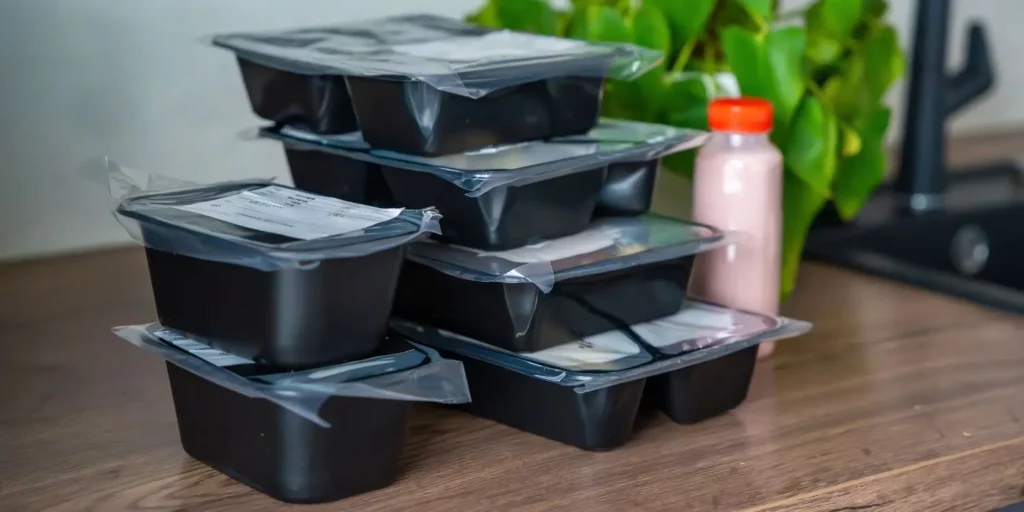
Modified atmosphere packaging (MAP) uses a mixture of gases selected according to the type of food and the preservation objective. Nitrogen helps prevent crushing, carbon dioxide inhibits the growth of bacteria and mould, and oxygen is mainly used to maintain the colour of fresh red meat. Choosing the right mixture depends not only on the product, but also on factors such as oxidation, microbial growth, the packaging material and the volume of gas inside the tray. For this reason, meat, cheese, ready meals and fish do not require the same protective atmosphere.
What is modified atmosphere packaging
Modified atmosphere packaging, also known as MAP or protective atmosphere packaging, is a technique that combines vacuum packaging with the injection of a gas mixture to provide better protection for the food inside the package. Its purpose is not only to extend shelf life, but also to prevent the product from being crushed, preserve its appearance and reduce problems such as oxidation or microbial growth, depending on the type of food. At Zermat, this system is mainly used with heat-sealed trays and is commonly applied to meat, cheese, dairy products, fish, fruit, vegetables, pasta and ready meals.
Unlike traditional vacuum packaging, MAP does not simply remove the air from the package. Instead, the internal atmosphere is replaced with a gas mixture suited to each product. Therefore, there is no single composition suitable for every type of food. The correct mixture depends on whether the aim is to prevent crushing, maintain colour, reduce oxidation or inhibit the growth of bacteria and mould. This is precisely the key to MAP packaging: choosing the right gas according to the actual characteristics of the food and the desired result.
How MAP packaging works
The MAP packaging process follows a clear sequence:
- First, the machine removes the air from inside the chamber or package to eliminate oxygen.
- Next, if the function is enabled, it injects the programmed gas mixture.
- Finally, it seals the package and decompresses the chamber to produce the finished pack.
This leaves the product protected in a modified atmosphere without becoming compressed, which is especially useful for fragile foods or products that need to retain their presentation.
In industrial applications, this process is mainly used with heat-sealed trays. Depending on the type of equipment and application, gas flushing may be used before sealing, or the process may combine vacuum extraction with gas injection. The latter is the most common option when the aim is to achieve a longer shelf life and provide better product protection.
Other factors also affect the stability of the final result, including the type of tray, the lidding film and whether the packaging material provides a sufficient barrier to retain both the vacuum and the gas mixture inside the package.
Which gases are used in modified atmosphere packaging
Modified atmosphere packaging does not use a single gas, but rather a mixture selected according to the type of food and the preservation objective. The most commonly used gases are nitrogen (N₂), carbon dioxide (CO₂) and oxygen (O₂), while argon (Ar) may also be used in certain cases. Each gas serves a different purpose: some help inhibit bacteria and mould, others maintain the product’s colour and others prevent the food from being crushed inside the package.
| Gas | Main function | When it is used | What it provides |
| Nitrogen (N₂) | Inert filling gas | Fragile products or foods sensitive to crushing | Prevents deformation and helps displace oxygen |
| Carbon dioxide (CO₂) | Microbiological control | Cheese, dairy products, ready meals, fish and other perishable foods | Inhibits bacteria and mould and helps extend shelf life |
| Oxygen (O₂) | Colour preservation | Mainly in fresh red meat | Maintains the red or pink colour and improves presentation |
| Argon (Ar) | Supporting inert gas | Specific applications requiring a stable protective atmosphere | Acts similarly to nitrogen and helps protect the product |
Nitrogen (N₂)
Nitrogen is one of the most widely used gases in MAP because it acts as an inert filling gas. Its main function is to occupy space inside the package without reacting with the food, helping to prevent the product from being crushed and to displace oxygen from the interior. For this reason, it is commonly used for delicate foods, products that need to retain their shape and mixtures designed to create a stable atmosphere without altering the characteristics of the food.
Carbon Dioxide (CO₂)
Carbon dioxide is essential when the main objective is to inhibit microbial growth. In practice, it is used to slow down bacteria and reduce mould growth, making it particularly useful for cheese, dairy products, fish, ready meals and other foods that are highly susceptible to spoilage. In many cases, it is the most important gas in the mixture because it directly helps to extend the product’s freshness and commercial shelf life.
Oxygen (O₂)
Oxygen is not always removed completely in MAP packaging. For some foods, it is beneficial to maintain a specific proportion inside the package, particularly for fresh red meat, where it helps preserve the red or pink colour consumers expect to see. For this reason, oxygen-rich mixtures are used for this type of product, sometimes with high percentages, provided that the machine, packaging and application are properly designed to work with this gas.
Argon (Ar)
Argon is used less frequently than nitrogen, carbon dioxide or oxygen, but it can also form part of a MAP gas mixture. It acts as an inert gas and serves a similar purpose to nitrogen: helping to protect the product and create a more stable internal atmosphere. It is generally reserved for specific applications where additional protection is required or where the gas mixture must be tailored to the particular needs of the food and packaging process.
How to choose the right gas for each product
The gas mixture used in MAP packaging should be selected according to the type of food and the desired outcome. Fresh red meat, where colour is a key factor, does not require the same atmosphere as cheese, a ready meal or fish, where the main objective is usually to slow microbial spoilage or prevent oxidation. Choosing the right mixture therefore requires identifying the main preservation challenge for each product and determining which gas is best suited to addressing it.
| Product | Desired outcome | Most commonly used gases | Main criterion |
| Fresh red meat | Maintain colour and extend shelf life | O₂ + CO₂ + N₂ | Oxygen helps preserve the red colour, while CO₂ inhibits bacterial growth |
| Cheese and dairy products | Slow microbial spoilage | CO₂ + N₂ | CO₂ is essential for extending freshness |
| Ready meals | Control microbial growth and oxidation | CO₂ + N₂ | The mixture depends on the type of recipe and how susceptible the product is to crushing |
| Fish and seafood | Reduce spoilage and maintain quality | CO₂ + N₂ | CO₂ helps inhibit microbial growth |
| Fruit and vegetables | Adjust preservation according to respiration rate and fragility | N₂ + CO₂ | The mixture must be adapted to the product and help prevent deformation |
Fresh red meat
In fresh red meat, the choice of gas is closely linked to colour. Gas mixtures with a high oxygen content are used for this type of product because they help maintain the red or pink appearance consumers expect. At the same time, carbon dioxide is added to inhibit bacterial growth and improve preservation. For this reason, MAP packaging for fresh red meat is intended not only to extend shelf life, but also to ensure an attractive presentation on the shelf.
Cheese and dairy products
In cheese and dairy products, the main concern is usually microbial spoilage. Carbon dioxide therefore plays a leading role, as it helps inhibit the growth of bacteria and mould. Nitrogen is used as a supporting gas to complete the mixture and stabilise the atmosphere inside the package. In general, the more delicate the cheese or the more susceptible it is to spoilage, the more important it is to adjust the proportion of CO₂ correctly.
Ready meals
For ready meals, the gas mixture is mainly selected to control two risks: microbial growth and oxidation. There is no single composition suitable for every product, as a moist dish does not have the same requirements as a dry one, and a fragile product differs from a more compact one. In many cases, CO₂ and N₂ are used to extend shelf life without crushing the product, while maintaining an appropriate presentation throughout distribution and sale.
Fish and seafood
For fish and seafood, the main priority is usually to reduce microbial spoilage and preserve product quality throughout its commercial shelf life. Carbon dioxide is once again one of the most important gases because it helps inhibit bacterial growth and extend freshness. Nitrogen completes the mixture and helps maintain the internal atmosphere of the package. With this type of food, choosing the wrong gas can significantly shorten shelf life.
Fruit and vegetables
Fruit and vegetables cannot be treated in the same way as meat or cheese, as their behaviour varies greatly from one product to another. The gas mixture must be adapted to the food’s fragility, respiration rate and the type of preservation required. Mixtures containing nitrogen and carbon dioxide are often used, but the specific product must always be assessed carefully to prevent deformation, loss of quality or insufficient preservation.
Factors to consider when choosing a gas mixture for MAP packaging
Choosing the right gas mixture for MAP packaging involves more than simply combining nitrogen, carbon dioxide and oxygen. To achieve an effective result, several factors related to the food, its preservation requirements and the packaging itself must be taken into account. The most important are:
- Type of food: Fresh red meat does not require the same gas mixture as cheese, fish or a ready meal. Each product has its own characteristics and reacts differently to the presence of O₂, CO₂ and N₂.
- Microbial growth: For many foods, the priority is to inhibit bacteria and mould in order to extend shelf life. In these cases, CO₂ usually plays a key role in the mixture.
- Oxidation and product colour: Some foods need protection against oxidation, while others require an attractive colour to be maintained for sale. For example, fresh red meat may require oxygen to preserve its red appearance.
- Packaging material and gas volume: Selecting the right mixture is not enough if the packaging does not provide a sufficient barrier or if the volume of gas inside the tray is inadequate. The lidding film, tray and headspace inside the package also affect the stability of the modified atmosphere.
MAP tray packaging: when is it the right choice
MAP tray packaging is suitable when the aim is not only to extend the food’s shelf life, but also to improve its presentation and prevent it from becoming deformed or crushed inside the package. It is widely used for fresh meat, fish, cheese, ready meals, pasta and retail products that need to reach the shelf with an attractive appearance, good visibility and a stable internal atmosphere.
It is also particularly useful for products sold in supermarkets, hypermarkets, catering services or through food delivery channels, as it allows different tray formats to be used and sealing to be combined with gas injection according to the product’s preservation requirements. Compared with other systems, MAP tray packaging provides a more commercial presentation, makes the product easier to display and allows the gas mixture to be adapted to both the food and the desired shelf life.
Differences between vacuum + gas, gas flushing and skin without gas
Although all three systems are used in tray sealing, they do not work in the same way or serve the same purpose. The main difference lies in how the atmosphere inside the package is modified and in the final result to be achieved.
- Vacuum + gas: The air is removed from the package and then replaced with a gas mixture. This is the most complete option when the aim is to achieve maximum preservation, better product protection and an atmosphere adapted to the food.
- Gas flushing: A full vacuum is not created. Instead, gas is introduced before sealing to partially modify the air inside the package. This can help extend shelf life, but it does not usually achieve the same level of preservation as a vacuum + gas system.
- Skin without gas: The product is vacuum-packed using a film that closely follows its shape like a second skin. No gas is injected. This system is mainly used when an attractive presentation and compact packaging are required, without the need to compensate for the internal atmosphere.
Common mistakes when choosing a gas for MAP packaging
One of the most common mistakes is assuming that there is a universal gas mixture suitable for every type of food. This is not the case: fresh red meat, cheese, ready meals and trays of fruit all have different preservation requirements. Choosing the wrong gas can therefore affect both the product’s shelf life and its presentation.
Another frequent mistake is focusing only on the gas while overlooking other factors that influence the result, such as the tray material, the barrier properties of the film, the gas volume inside the package and the subsequent storage temperature. Even the right gas mixture will not be effective if the package cannot retain the internal atmosphere properly or if the product is not stored under suitable conditions.
A further common error is using oxygen, carbon dioxide or nitrogen without clearly understanding the role of each gas. For example, it is not always advisable to remove oxygen completely, nor is it always appropriate to add it. This depends on the type of food and the desired effect. For this reason, MAP is not simply a matter of “adding gas”: the product, the preservation objective and the packaging system must all be clearly defined before selecting the most suitable mixture.